Because I Was in the Room: Bringing AACR Science Back to Metastatic Patients
This guest post is one of a series of reports back from patient advocates who attended cancer conferences in 2026 with the help of a travel scholarship from the MBC Alliance’s Shirley Mertz Memorial Travel Grant Program. Read the author’s 2025 report-back here.
 By Marybeth Gilliam | Individual Advocate Member & Travel Grant Recipient
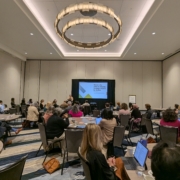
I am deeply grateful to the Metastatic Breast Cancer Alliance for awarding me a Shirley Mertz Travel Award to support my participation in the American Association for Cancer Research (AACR) Annual Meeting in San Diego, CA. Without this travel support, I would not have attended.
That matters because AACR is not a typical destination for many patient advocates. The science is dense. The sessions are highly technical. Much of the language is built for researchers speaking to other researchers. But for those of us living with metastatic cancer, or advocating for people who are, the science being discussed at AACR is not abstract. It is where the future of cancer care is being built.
Empowering fellow metastatic patients to outperform cancer
For me, the most valuable part of attending AACR was not only what happened inside the formal conference sessions. It was also the meetings, conversations, and unexpected opportunities that happened around the conference. Those experiences changed what I understand to be possible in cancer care, and they are already helping me support other patients.
One of the most meaningful opportunities I had was attending a meeting where Sid Sijbrandij presented his personal experience with osteosarcoma.
Sid followed the best available standard of care. But when his cancer returned, he was eventually told there was nothing more that could be done. Many metastatic patients understand the weight of that sentence. It is devastating. It can feel like the end of the road.
Sid responded differently.
As the co-founder and Board Chair of GitLab, he is an engineer, an entrepreneur, a builder of systems, and above all, a problem solver. When the standard system ran out of options, he went into what he calls “founder mode.” He assembled a team. He began approaching his cancer like a complex engineering problem. He wanted data—deep data—to understand why he had cancer, what was driving it, and what might make it vulnerable.
He pursued extensive testing. He looked for every possible signal. He explored emerging technologies and treatments, including radioligand therapy and therapeutic cancer vaccines designed to help activate his immune system against the cancer. Over time, the number of T cells infiltrating his tumor increased dramatically. His cancer became undetectable. He has now been cancer-free for more than a year.
As patients, we sometimes hear extraordinary stories like Sid’s. I have one of my own. I went from having metastatic breast cancer in my heart, skull, spine, hips, ribs, and throughout my lymphatic system to no evidence of disease in less than three months after receiving treatment. I have now been cancer-free for six years.
But Sid’s story is unique for another reason.
There have been many people with wealth and cancer. Some had access to extraordinary resources. But Sid is not simply using resources for himself. At every point where he encountered a barrier in the healthcare system, he began thinking about how to build something that could help overcome that barrier for others.
That resonated deeply with me.
Before founding Outperform Cancer, I was the Chief Operating Officer of a marine robotics company. I have spent much of my life thinking about systems, inefficiencies, failure points, and how to solve problems. When I became a metastatic breast cancer patient, I saw a major gap in cancer care.
It is a doctor’s job to deliver excellent standard of care. It is a researcher’s job to make discoveries. But between those two worlds is an enormous space where important scientific findings can sit for years before reaching patients.
A discovery may be early. It may be mature. It may be 10 percent of the way toward becoming standard of care, or 99 percent of the way there. But if it is not yet standard of care, most patients will never hear about it in the clinic. That is not because doctors do not care. It is because doctors are already overwhelmed trying to deliver the best available standard treatments in very limited time.
I saw high-quality research with real potential to help patients languishing in this “no man’s land.” Some of it involves interventions that may have meaningful upside and relatively low risk when discussed appropriately with a patient’s medical team. Yet most patients never learn these ideas exist.
That is why I started Outperform Cancer.
One example is the work of Dr. Abby Overacre on sucralose and immunotherapy. Her research suggests that sucralose, a common artificial sweetener, may interfere with the effectiveness of immune checkpoint inhibitors by altering the gut microbiome and disrupting arginine metabolism, which is important for T-cell function. In mouse models, strategies that restored arginine availability helped restore immunotherapy response. And, in a phase II clinical trial, she observed further confirmation of her work.
This kind of finding is not the same as a clinical guideline. It still requires a phase III clinical trial. But if I were a patient about to receive immunotherapy, I would want to know that this research exists. I would want the option to eliminate sucralose from my diet – something that certainly won’t hurt me and might have an enormous effect on my cancer outcome.
For a patient, that information could matter. A small behavior change may not cure cancer. But when the stakes are response versus no response, or life versus death, patients deserve access to credible scientific information that may help them make better-informed decisions.
This is the space where patient advocacy can make a difference.
How patient advocacy can help drive better outcomes
Meeting Sid at AACR helped me see a larger version of this same mission. As a patient, he has great empathy for people who have been told there are no more options. But unlike most patients, he also has the financial means, engineering mindset, and entrepreneurial experience to begin building a different kind of operating system for cancer care.
One of the most important examples is Future of Cancer Care Today, an initiative of the Sijbrandij Foundation. The organization provides a non-clinical support layer for patients navigating complex cancer treatment decisions, with a focus on education, information, and decision support that complements—not replaces—the relationship between patients and their medical teams.
Since learning about Future of Cancer Care Today through AACR, I have already directed several patients there. These are people who often began the conversation feeling depressed and believing there was nothing left to do. They came away with more hope, better questions, and a clearer action plan to discuss with their doctors.
That is exactly what patient advocacy should do.
It should not promise cures. It should not replace medical care. But it can help patients see that “nothing more we can do” is not always the same thing as “nothing more exists.” Sometimes it means the next option is outside the usual path. Sometimes it means deeper testing, a clinical trial, a new technology, or a better-informed question.
If I had not attended AACR, I would not have met Sid in person. I would not have learned enough about Future of Cancer Care Today to begin directing patients to that resource. And I would not have had the opportunity to help tell Sid’s story through my Outperform Cancer podcast.
AACR also opened another important door. While there, I met leaders from the Foundation for the National Institutes of Health who are helping lead an initiative requested by National Cancer Institute Director Dr. Anthony Letai to accelerate therapeutic cancer vaccines. Because I was at AACR, I was able to attend an onsite meeting with the research team. I am now a regular participant in the committee working to help bring this important technology closer to patients.
That opportunity would not have happened without being in the room.
The Shirley Mertz Travel Grant Award did far more than help me attend a scientific meeting. It helped me build relationships, discover resources, and connect with people working to change the future of cancer care. It allowed me to bring back information that is already helping metastatic patients feel less alone and more empowered.
For people living with metastatic breast cancer, time matters. Access matters. Information matters.
Until we have cures, I believe we should use every credible tool available to help patients live longer and better lives. Standard of care is essential. But it should not be the ceiling of our imagination. Research, biomarkers, clinical trials, emerging technologies, lifestyle science, and patient-driven questions all have a role to play.
I am grateful to the Metastatic Breast Cancer Alliance for making it possible for me to attend AACR. The impact of that support did not end when the conference ended. It is continuing through every patient I am able to help, every researcher I am able to learn from, and every conversation that moves us closer to a future where metastatic patients have more options, more agency, and more hope.